

Top 5 IT Trends Transforming Businesses in 2025
In a frantically fast-paced digital economy, knowing about IT trends is not a question of choice but imperative for being ahead of the pack. Companies that procrastinate in applying new technologies or treat them as a cost element in the back room rather than an opportunity for innovation may find that competitors of greater agility surpass them.
As we enter the year 2025, the tempo of change in technology products is becoming intensified. Changes in technology mean new products, new ways of offering products, new expectations from buyers and from employees alike.
For a company like WT Softech, in the IT services, consulting and software development business, knowing the forces which are influencing the future is at once an obligation and an opportunity.
Why Staying Ahead of IT Trends Matters
- Competitive Advantage: Companies that are first in using the new technologies identified have stronger productivity, improved customer service, and new revenue possibilities.
- Cost Optimisation: At maturity, all technology products become cheaper, more automated and of more economic consequence if they are taken advantage of at the right time.
- Talented Manpower Attraction and Retention: Developers, engineers and consultants want to work at the leading edge of platform technology and do not want to spend their time in mere legacy program maintenance.
- Risk Management: New technology products bring new security, compliance and governance risk. Advanced knowledge equips a company to anticipate and mitigate problems.
- Client Corroboration of Trust: If WT Softech can counsel its clients in the acquisition of leads that are desirable, it finds itself buried in the ranks of those who are forward-thinking or at least not one who merely fulfils orders.
The sections that follow will examine five areas of IT interest and importance at this time, already influencing their business in the year 2025.
AI in IT Consulting
Artificial Intelligence (AI) continues to dominate the technology agenda, and in 2025, it has moved from experimental to integral. According to Deloitte and McKinsey, AI is becoming woven into the very foundation of IT architecture and business models.
Among the most significant IT consulting trends, the integration of AI stands out as a game-changer, reshaping how consulting firms design strategies, optimise processes, and deliver value to clients across industries.
The Shift in AI Maturity
In prior years, many organisations were “experimenting with AI.” By 2025, the pattern has changed: AI is being scaled, embedded, and governed. For instance, IBM found that 46% of executives expect to scale AI in core operations, and 44% view it as a source of innovation. AI is no longer a bolt-on; it’s a baseline expectation.
Key Implications for IT Consulting
- Strategic Alignment over Pilot Projects: Integrate AI into core systems, ERP, CRM, and supply chain.
- Human + Machine Collaboration: AI augments humans with workflows, collaboration models, upskilling, and change management.
- Responsible AI, Governance, Risk & Compliance:Ethics, transparency, bias mitigation, explainability, privacy, and regulatory compliance.
- Agentic AI & Autonomous Systems: Advisory on tasks for autonomous systems, monitoring and risk mitigation.
Use Cases & Business Impact
- Predictive Operations: Forecasting demand, downtime, or bottlenecks.
- Generative Assistance: AI-generated code, content, or design proposals.
- Intelligent Agents: Bots or virtual assistants that take action.
- Decision Support: Insights and recommendations for leadership.
How WT Softech Can Leverage AI
- Develop AI-powered consulting packages: assessments, roadmaps, pilots, scaling.
- Build vertical domain expertise (finance, manufacturing, retail, healthcare).
- Offer governance and compliance modules: audits, bias assessments, explainability.
- Combine AI with cloud, agile, automation for integrated offerings.
Cloud-Driven IT Services
Cloud computing has been a mainstay for years, but in 2025, its role is evolving: the cloud is no longer just infrastructure but part of the intelligent backbone of businesses.
Managed IT support has become essential for maintaining these complex cloud environments, ensuring security, optimisation, and reliability as businesses increasingly depend on cloud-based ecosystems.
The Evolution of Cloud Services
- Cloud-Native Architecture Adoption: Microservices, serverless, containers.
- Hybrid and Multi-Cloud Dominance: Avoid vendor lock-in, resilience, best-of-breed.
- Edge and Distributed Cloud: Reduce latency and capacity constraints.
- Cloud Automation & IaC: Declarative, self-healing infrastructure.
- Managed Cloud Services/Platform Engineering: Full-stack support, monitoring, optimisation.
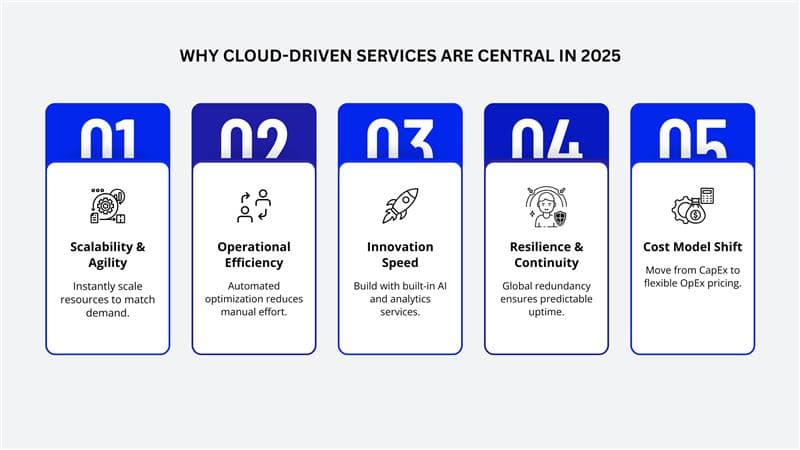
Why Cloud-Driven Services Matter
- Scalability & Agility: Expand or contract quickly based on demand.
- Operational Efficiency: Less manual overhead, more optimisation.
- Innovation Speed: Leverage built-in cloud services instead of building from scratch.
- Resilience & Business Continuity: Geographic redundancy, predictable uptime.
- Cost Model Shift: From CapEx to OpEx, pay-as-you-go pricing.
Managed IT Support in the Cloud Era
- CloudOps: Monitoring, incident response, optimisation across cloud stacks.
- Platform Engineering Teams: Internal platforms for developer productivity.
- DevSecOps: Continuous security integration.
- AI/ML-Powered Monitoring & Auto-Remediation.
WT Softech Approach
- Cloud transformation packages: assessment, migration, modernisation, optimisation.
- Cloud competency centres: AWS, Azure, GCP, Kubernetes.
- Managed cloud service plans: monitoring, backup, security, compliance, cost governance.
- Internal platform innovation: reusable microservices, shared components.
- Combine with AI services: cloud-based AI inference, automated ML pipelines.
Agile Product Development
In 2025, agile software development continues to define how modern teams create, test, and scale digital products efficiently. Businesses prioritise flexibility, collaboration, and speed.
- Scaled Agility / Business Agility: Entire business adopts agile mindset.
- Lean Startup + MVP Thinking: Incremental release across internal and external products.
- Continuous Delivery & DevOps Integration: CI/CD, automated testing, infrastructure as code.
- Product-Centric Mindset: Long-lived product teams guided by value metrics and feedback.
- Experimentation, A/B testing, Data Feedback Loops: Analytics and telemetry drive iterations.
Automated Software Testing
Manual testing is fading in 2025, replaced by automated, AI-assisted, continuous testing to detect bugs, validate stability, and deliver high-performing applications at scale.
- Speed: Continuous delivery demands fast testing cycles.
- AI & ML: Smarter test generation, prioritisation, anomaly detection, self-healing suites.
- Industry Adoption: Automation is now the default in IT operations.
Digital Marketing for Tech Firms
Visibility and engagement are crucial. A well-defined digital marketing strategy helps tech companies reach the right audience, generate qualified leads, and build lasting credibility.
- Complex Buyer Journeys: Multiple stakeholders, longer cycles, technical evaluation.
- Content & Thought Leadership: Whitepapers, tutorials, webinars, case studies, blogs.
- SEO Challenges for IT: Domain specialisation, thematic authority, semantic SEO.
- Account-based Marketing (ABM): Focus campaigns on high-value accounts with personalised messaging.
- Performance Marketing: Precise measurement, multi-touch attribution, ROI metrics.
- AI in Marketing: Tools for content generation, predictive analytics, chatbots, lead scoring.
Summary
In 2025, technology is reshaping how businesses operate, innovate, and compete. From AI integration to cloud scalability, agile MVP development, QA automation, and smart digital marketing, each trend empowers companies to stay future-ready. For WT Softech, mastering these trends means leading clients confidently through the next era of digital transformation.